Friday, June 7, 2013
2014 Toyota Corolla!
Well, Toyota has officially revealed the 2014 Corolla and here it is!


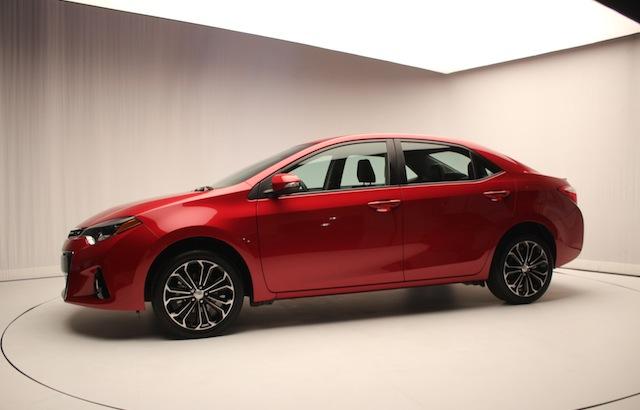


There will be four different trim levels when the vehicle gets released during the Fall of 2013. The trim levels are as follows; L, LE, S & LE Eco. There are going to be two different 1.8L 4 cylinders available with one producing 132hp, similar to the 2012's and the other putting out about 140hp. The bump in power is due to Toyota's new Valvematic technology. The 2014 Corolla will be the first Toyota in the U.S. with this technology. There will be three different transmissions available as well. The first is a 4 speed automatic which has been around for years. The next is a 6-speed manual gearbox which is new for the Corolla. The last transmission is Toyota's version of a CVT (continuously variable transmission) which they call a CVTi-S. The "i" stands for intelligence and the "S" refers to shift. Toyota claims to have combined the benefits of a CVT with the feel of a conventional hydraulic transmission so only time will tell how well they accomplished this task.
More information can be found at Autoblog.com along with the full press release from Toyota.
As soon as we get our first one in, I will be sure to do a walk-around video of it and go over the features and options!


Friday, March 22, 2013
I just realized what today is. Eleven years ago today, I started selling Toyotas. Actually, I didn't sell my first two cars until the next day. (Fast learner I guess.....rather be lucky than good right?!?) I'd like to thank all my customers past, present and future and if there is anything that is needed, just let me know and I will do my best to accommodate you!
Also, March 27th at the New York Auto Show, Toyota will be unveiling the new 2014 Highlander and 2014 Scion tC! Make sure to check them out!
Also, March 27th at the New York Auto Show, Toyota will be unveiling the new 2014 Highlander and 2014 Scion tC! Make sure to check them out!
Sunday, March 17, 2013
2013 Toyota FJ Cruiser Trail Team Edition
Here is a walkaround video of the 2013 Toyota FJ Cruiser Trail Team Edition. I finally edited the footage and uploaded it. Subscribe to my YouTube channel or my blog for more videos. Better yet, why not both!
Thursday, February 7, 2013
2014 Toyota Tundra revealed!

Toyota has officially revealed the 2014 Tundra at the Chicago Auto Show. Here are some of the pictures that they shared.


Tuesday, January 15, 2013
New 2013 Toyota Avalon and 2013 Toyota Rav4 Videos
I had the chance to make some walk-around videos of the 2013 Avalon Limited and a 2013 Rav4 XLE AWD. The Rav4 video has some driving footage at the end. The Avalon was sold prior to arriving so I could not do a driving portion in the video. Let me know what you think and subscribe on YouTube to get updated when I make more videos. I am planning on making one for each model in the Toyota lineup.

2013 Avalon Limited Walkaround / Features / Review
2013 Toyota Rav4 XLE AWD Walkaround / Features / Review
This has to be one of the best accessories that I have bought for any of my devices. I absolutely love this case/keyboard. It's definitely worth the money and is extrememely easy to set up. Check out the Zaggfolio for yourselves if you do not own one already!
Saturday, January 5, 2013
FR-S Section Updated
I updated the page for my 2013 Scion FR-S with some new videos of my exhaust and playing around. Check them out by clicking the link in the bar above this post!
Tuesday, July 3, 2012
Star Safety System - Part Two
It's been a while since I did part one, but now I'm going to cover part two which will include Vehicle Stability Control (VSC), Brake Assist (BA), Electronic Brake Force Distribution (EBD) and Smart Stop Technology.


Vehicle Stability Control
Vehicle stability control is essentially traction control for when the vehicle is in motion. The program is designed to keep the vehicle on it's intended path. It does so through a complex set of sensors that measure steering input, vehicle speed, individual wheel speed sensors, throttle input and yaw sensors. It is not a substitute for safe driving, but it can help a great deal in emergency situations when a driver has to make evasive actions.
The system will reduce throttle input even if you put the pedal to the floor if it senses a loss of control or traction. This system can greatly reduce the risk of rollovers in SUV and trucks that have a high center of gravity. The government did studies that show that 41% of single vehicle accidents could have been avoided if all vehicles were equipped with this system. This led to the mandate that all vehicles 2012 model year and newer are required to have a stability control program as standard equipment. The system has been standard on all Toyota SUV's since 2004.
Here's a video clip of a 2013 Scion FR-S on a wet slalom course with the system turned on (default mode), then in Sport VSC mode (most cars don't have this mode) and then finally with all the systems turned off. As you will see, the program helps a ton on maintaining control of the vehicle.
If you want to read in more detail about this program, you can do so here on Wikipedia
Brake Assist
Brake assist is another program designed to increase the safety of new vehicles. The program will detect a "panic" braking situation and apply maximum braking force. It will do this by the speed the brake pedal is depressed. Studies have shown that drivers may not always be able to apply maximum braking pressure on the pedal due to seating position, physical ability and other reasons. Brake assist has been shown to reduce stopping distances by a significant margin, up to 20% in some studies.
Brake assist doesn't interfere with normal driving situations and you will most likely not even notice it working when it engages. If you quickly stab on the brake pedal like you are going to "panic" stop and then let up on the brake pedal, then you may notice that the vehicle still slows to a stop just like if you were standing on the brake pedal.

Electronic Brake Force Distribution
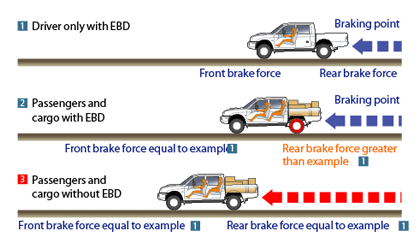
Electronic brake force distribution will vary the braking pressure applied to each individual wheel depending on the load of the vehicle, speed and road conditions. Most of the time under normal conditions, the majority of the braking force is applied to the front wheels because that is where the majority of the load is on a vehicle.
A truck is a great example to use. Normally a truck is very biased as far as weight goes towards the front of the vehicle. Now, put a load of mulch/cargo/etc into the bed of the truck and it's weight distribution is very different. It will now have more weight towards the back of the vehicle than normal. EBD will recognize this and transfer more braking pressure to the rear of the vehicle to get a more controlled and shorter stopping distance by applying braking force to each wheel individually.
Smart Stop Technology
Smart Stop Technology was created by Toyota as a measure to prevent unintended acceleration. This technology is a result of the recalls from 2009-2010. The way the system works is that it will reduce engine power when both the brake and gas pedal are pushed at the same time under certain conditions. Smart Stop will engage when the accelerator is pressed first and the brake is applied firmly for longer than one-half second at speeds greater than 5mph.
In normal driving situations, you won't even notice this program. If the brake pedal is pressed first, and then the accelerator, the system will not engage. This is to prevent the system from engaging when you are starting out on a hill and want to prevent the vehicle from rolling backwards
Monday, June 4, 2012
Star Safety System - Part One
Toyota has a group of safety features that make up the Star Safety System. They are as follows: anti-lock brakes (ABS), traction control (TRAC), vehicle stability control (VSC), brake assist (BA), electronic brake force distribution (EBD) and smart stop technology (SST). I will go through each one of them and explain what they are and how they work. The first two systems that I will cover will be ABS and traction control. If it wasn't for the first of these systems, ABS, the rest of them would not be possible.
Anti-Lock Braking System
Most people today have owned a vehicle with ABS or have at least heard about ABS. ABS is an electronic braking system that prevents the wheels from locking up and skidding thus allowing the driver to maintain steering control around an obstacle/object on the roadway. With an ABS equipped vehicle, it is not necessary to "pump" the brakes, especially in an emergency situation. The vehicle will do it for you and much faster than any person would be able to do on their own. The driver will feel a "pulsing" in the brake pedal and this is the valves in the system opening and closing. Some anti-lock braking systems can cycle as many as 16 times per second.
There are a few different types of ABS. I will cover the three most popular. The best system is what is referred to as a four-channel, four-sensor system. This system has valves and wheel speed sensors for all four wheels. It will monitor each individual wheel to make sure it has maximum braking force possible applied to it. This is the type of system that Toyota uses in its vehicles. The second type of system is referred to as a three-channel, four-sensor system. This type of system has wheel speed sensors for all four wheels but only one valve for both rear wheels so both rear wheels will have the same brake pressure applied no matter what amount of load/traction they have. The third type of system is called a three-channel, three-sensor system. This is normally found on pick up trucks, but not current Toyota's (Toyota uses 4-channel, 4-sensor). This system has two wheels speed sensors and valves for each front wheel and one sensor and a valve in the rear axle for both rear wheels. The downside to this system is that one of the rear wheels can still lock up and skid before the rear ABS kicks in and therefore increases the stopping distance. In summary, not all ABS are created equal!
Here's an example of what an ABS modulator will look like under the hood of your car. It is typically mounted near the front, left of the engine compartment. It will have a bunch of brake lines coming in and out of it.

Traction Control
Traction control is an electronic system that works with a vehicle's ABS and throttle control units. Traction control will engage when one of the drive wheels is spinning significantly faster than the other. For example, one tire is on a patch of ice and the other is on the normal road surface. Without traction control, the wheel that is on ice would just keep spinning. With traction control, the wheel that is on ice is spinning faster than the other (if the other wheel is moving at all), and the system will apply the brakes (ABS) to the spinning wheel to force power to the other wheel that is on the normal road surface. Once the power is transferred to the "wheel with grip", the vehicle will move forward . In cases of severe traction loss, the traction control system may also reduce spark and fuel to one or more cylinders, apply ABS, and/or close the throttle on electronic throttle controlled (drive-by-wire) vehicles, which most are today.
Traction control can make getting a vehicle "un-stuck" more difficult. In a front-wheel drive vehicle, if you would be stuck in snow or whatever, it's usually best to get the vehicle to rock back and forth to free it up. Traction control would make this action more difficult. Luckily, most new vehicles will have a button (see picture below) to disable the traction control system that will allow the wheels to spin freely and may make getting the vehicle out of a difficult situation a little easier. For normal driving though, leave traction control engaged because it will usually help you more than you may even know it.
Here's a picture of what a typical Toyota traction control button will look like.

Anti-Lock Braking System
Most people today have owned a vehicle with ABS or have at least heard about ABS. ABS is an electronic braking system that prevents the wheels from locking up and skidding thus allowing the driver to maintain steering control around an obstacle/object on the roadway. With an ABS equipped vehicle, it is not necessary to "pump" the brakes, especially in an emergency situation. The vehicle will do it for you and much faster than any person would be able to do on their own. The driver will feel a "pulsing" in the brake pedal and this is the valves in the system opening and closing. Some anti-lock braking systems can cycle as many as 16 times per second.
There are a few different types of ABS. I will cover the three most popular. The best system is what is referred to as a four-channel, four-sensor system. This system has valves and wheel speed sensors for all four wheels. It will monitor each individual wheel to make sure it has maximum braking force possible applied to it. This is the type of system that Toyota uses in its vehicles. The second type of system is referred to as a three-channel, four-sensor system. This type of system has wheel speed sensors for all four wheels but only one valve for both rear wheels so both rear wheels will have the same brake pressure applied no matter what amount of load/traction they have. The third type of system is called a three-channel, three-sensor system. This is normally found on pick up trucks, but not current Toyota's (Toyota uses 4-channel, 4-sensor). This system has two wheels speed sensors and valves for each front wheel and one sensor and a valve in the rear axle for both rear wheels. The downside to this system is that one of the rear wheels can still lock up and skid before the rear ABS kicks in and therefore increases the stopping distance. In summary, not all ABS are created equal!
Here's an example of what an ABS modulator will look like under the hood of your car. It is typically mounted near the front, left of the engine compartment. It will have a bunch of brake lines coming in and out of it.

Traction Control
Traction control is an electronic system that works with a vehicle's ABS and throttle control units. Traction control will engage when one of the drive wheels is spinning significantly faster than the other. For example, one tire is on a patch of ice and the other is on the normal road surface. Without traction control, the wheel that is on ice would just keep spinning. With traction control, the wheel that is on ice is spinning faster than the other (if the other wheel is moving at all), and the system will apply the brakes (ABS) to the spinning wheel to force power to the other wheel that is on the normal road surface. Once the power is transferred to the "wheel with grip", the vehicle will move forward . In cases of severe traction loss, the traction control system may also reduce spark and fuel to one or more cylinders, apply ABS, and/or close the throttle on electronic throttle controlled (drive-by-wire) vehicles, which most are today.
Traction control can make getting a vehicle "un-stuck" more difficult. In a front-wheel drive vehicle, if you would be stuck in snow or whatever, it's usually best to get the vehicle to rock back and forth to free it up. Traction control would make this action more difficult. Luckily, most new vehicles will have a button (see picture below) to disable the traction control system that will allow the wheels to spin freely and may make getting the vehicle out of a difficult situation a little easier. For normal driving though, leave traction control engaged because it will usually help you more than you may even know it.
Here's a picture of what a typical Toyota traction control button will look like.

In my next post, I will cover vehicle stability control (electronic stability control) and how it works and it's many benefits. Bookmark my site or subscribe to my blog via email or your RSS reader to get the update when I finish the next article and any future articles. You can bookmark my site by pushing CTRL+D on your keyboard.
Subscribe to:
Posts (Atom)